Professional lawn care delivers better results than DIY maintenance in Baton Rouge because the Gulf South climate creates a narrow, unforgiving window for every turf treatment. From soil compaction in our heavy red clay to fungal outbreaks triggered by high humidity and torrential rainfall, Baton Rouge lawns demand precise timing and species-specific knowledge that most homeowners do not have time to develop. While a weekend mowing routine can keep grass from looking wild, it rarely addresses the root-level conditions that determine whether a lawn actually thrives or simply survives. The right choice between professional service and DIY depends on your grass type, soil condition, and how much you are willing to invest in learning the science behind each seasonal treatment through effective lawn care strategies.
TL;DR
- Baton Rouge sits in USDA Hardiness Zone 9a, meaning mild winters and hot, humid summers that favor warm-season grasses like St. Augustine, centipede, and Bermuda grass, each with distinct fertilization and mowing requirements
- Soil testing is the foundation of effective lawn care, yet most DIYers skip it and apply generic fertilizer that can damage specific grass species, especially centipedegrass, which declines with excess nitrogen
- Core aeration, thatch control, and proper irrigation scheduling require specialized equipment and timing that align with soil temperatures, not calendar dates
- Misapplied fertilizers and pesticides contribute to nutrient runoff into local waterways, a concern the EPA actively addresses through its recommended lawn care practices
- Professional programs coordinate pre-emergent applications, disease prevention, and seasonal fertilization into a unified schedule built around Baton Rouge’s March-through-October growing season
Baton Rouge Climate and Why It Punishes Lawn Care Mistakes
Baton Rouge falls squarely within USDA ARS – 2023 Plant Hardiness Zone Map, where average minimum winter temperatures range from 20 to 30 degrees Fahrenheit. The growing season stretches from March through October, but it is what happens during those months that makes lawn care here difficult. Intense summer heat, oppressive humidity, and frequent heavy rainfall create an environment where fungal diseases, thatch buildup, and nutrient leaching happen fast and compound quickly. A fertilizer application that would be beneficial in a drier climate can wash into storm drains or trigger a brown patch outbreak after one of Baton Rouge’s summer downpours.
The LSU AgCenter’s updated zone classification confirms that Louisiana’s zones have shifted, with Baton Rouge now firmly in zone 9a, a half-zone warmer than the previous map. This warming trend extends the active turfgrass season, which sounds positive but actually increases the management burden. Longer growing seasons mean more mowing, more thatch accumulation, and a wider window for pest and disease pressure.
Grass-Specific Requirements That Trip Up Most Homeowners
The LSU AgCenter’s Louisiana Lawn Maintenance (Pub. 2293) outlines precise maintenance recommendations for each turfgrass species grown in the state. The differences are not minor. St. Augustinegrass requires a mowing height of 2 to 3 inches with 2 to 4 pounds of nitrogen per 1,000 square feet per year. Centipedegrass, by contrast, needs only 1 to 2 pounds of nitrogen annually and a cutting height of 1 to 2 inches. Applying centipede’s modest nitrogen rate to St. Augustine produces a thin, yellowed lawn. Applying St. Augustine’s rate to a centipede can kill it outright.
Fertilization timing matters just as much as the rate. The LSU AgCenter’s schedule shows that nitrogen applied to warm-season grasses outside the recommended months is wasteful and can harm the turf. Applying nitrogen too late in the fall increases the risk of winter kill, while summer applications on certain species must be carefully managed to avoid excessive growth that weakens root systems. These are not rules of thumb. They are species-specific, research-backed schedules that change depending on whether you are growing common Bermudagrass, hybrid Bermudagrass, zoysia, St. Augustine, or centipede, which is why many homeowners rely on professional lawn care services for proper turf management.
| Grass Type | Mowing Height (Inches) | Nitrogen (Lb./1,000 Sq. Ft./Year) | Preferred Mower | pH Range |
|---|---|---|---|---|
| St. Augustine | 2 to 3 | 2 to 4 | Rotary | 6.0 to 7.5 |
| Centipede | 1 to 2 | 1 to 2 | Rotary | 5.0 to 6.0 |
| Common Bermuda | 1 to 1.5 | 3 to 4 | Reel | 5.8 to 7.2 |
| Hybrid Bermuda | 0.75 to 1 | 4 to 6 | Reel | 5.8 to 7.2 |
| Zoysia | 1 to 2 | 2 to 3 | Reel | 5.8 to 7.2 |
Soil Health: The Layer Most DIY Programs Ignore
A lawn is only as healthy as the soil beneath it. The University of Georgia’s turfgrass fertility research emphasizes that poor growth is often caused by factors entirely unrelated to fertilizer. Compacted soils, excess thatch, improper pH, and poor drainage all restrict root development, and no amount of nitrogen will compensate for those physical problems.
Core aeration is one of the most impactful practices for Baton Rouge lawns, particularly on our heavy clay soils. An aerator removes plugs from the soil, allowing immediate penetration of water, air, and nutrients into the root zone. UGA Extension recommends that warm-season grasses be aerated when soil temperatures at the 4-inch depth reach at least 65 degrees Fahrenheit and are rising. This timing matters because aeration performed too early, when roots are not actively growing, produces little benefit and can stress the turf. Improper timing is one of the most common lawn care mistakes homeowners make.
Soil pH is another factor that homeowners routinely overlook. Each turfgrass species has an ideal pH range, and even a half-point deviation can reduce nutrient availability. The UGA Extension notes that soil pH that is too low or too high decreases the amount of nutrients absorbed by plant roots. In Baton Rouge, our naturally acidic soils can drift below the optimal range for some grasses, making lime applications necessary. Conversely, applying lime to centipedegrass without a soil test can push the pH too high and contribute to decline. Testing soil every two to three years, as recommended by the LSU AgCenter, is the only reliable way to know what adjustments are actually needed.
Environmental Responsibility and Why It Matters in Baton Rouge
The EPA’s guidance on the US EPA – Lawn and Garden directly connects homeowner practices to water quality. Fertilizers and pesticides that are misapplied or overapplied run off into local waterways during our heavy rain events. Baton Rouge’s flat terrain and clay-heavy soils slow infiltration, which increases the chance that nutrients from lawn treatments reach storm drains before they reach root zones.
The EPA recommends Integrated Pest Management, an approach that combines multiple methods to control pests with the least possible hazard to people, property, and the environment. This means proper identification of pests before treatment, correct product selection, precise application rates, and timing applications to avoid rain. These are the practices our team follows on every property, and they are the practices most likely to be skipped or improvised in a DIY program.
The EPA’s additional guidance on US EPA – What You Can Do: In Your Yard specifies that fertilizers should be applied only when necessary and at the recommended amount, never on windy or rainy days, and as close as possible to the period of maximum grass uptake. For warm-climate grasses in Baton Rouge, that means early and late summer applications, not the spring-only approach many homeowners follow.
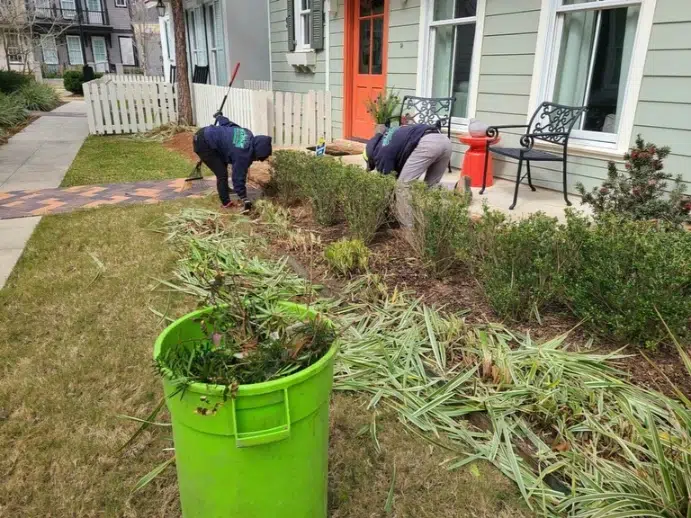
What Professional Care Gets Right That DIY Usually Gets Wrong
The gap between professional and DIY results comes down to three things: coordination, calibration, and consistency.
Coordination means that every treatment is part of a planned sequence. Pre-emergent herbicides go down before weed seeds germinate. Fertilization aligns with the grass species’ active growth periods. Aeration happens when soil temperatures support recovery. Each treatment builds on the last one, and nothing is applied at the wrong time or in the wrong sequence.
Calibration means that the equipment is set to deliver the exact rate recommended for the product and the grass type. Broadcast spreaders produce heavy spots and thin spots unless they are set to half rate and covered at half swath width. Most homeowners set their spreader once and never recalibrate, leading to striping, burn patches, and wasted product.
Consistency means the lawn receives attention on a regular schedule, not whenever time allows. A missed pre-emergent window in March creates a summer full of crabgrass. A skipped fall potassium application reduces winter hardiness. These individual lapses accumulate into a visible decline that takes multiple seasons to reverse.
Which Approach Works Best for Your Situation
| Property Profile | Recommended Approach | Key Reason |
|---|---|---|
| Small lot, centipede grass, low expectations | DIY with soil test guidance | Centipede requires minimal inputs; over-maintenance does more harm than under-maintenance |
| St. Augustine lawn, shade trees, visible thinning | Professional program | St. Augustine demands precise nitrogen timing and is vulnerable to fungal disease in shaded, humid areas |
| New construction with compacted subsoil | Professional with aeration and soil amendment | New builds often have stripped topsoil and hardpan that require mechanical correction before any fertilization |
| Large lot, mixed grass types, HOA standards | Professional program with seasonal adjustments | Mixed-species lawns need different treatment rates for different zones, which is difficult to manage without training |
| HOA-managed community property | Professional with documented plans | HOA requirements and shared drainage areas demand professional documentation and environmental compliance |
Signs You Have Found the Right Lawn Care Provider
- They start with a soil test before recommending any treatment, rather than applying a standard program to every lawn
- They identify the specific grass species present on your property and adjust mowing heights, fertilization rates, and treatment timing accordingly
- They explain what they are applying, why, and when you should expect to see results
- They follow a written schedule and communicate upcoming treatments in advance
- They practice responsible nutrient management, avoiding applications before forecast rain and calibrating equipment before each use
Ready to Let Professionals Handle Your Baton Rouge Lawn
Our team at All Seasons Landscaping & Lawn Care brings the training, equipment, and seasonal knowledge that Baton Rouge lawns demand. We build every treatment plan around your property’s specific grass type, soil condition, and growing environment, so nothing is left to guesswork. Whether your lawn needs a full seasonal program or targeted help with a specific problem, we are ready to make it right.
Reach us at [email protected] or call (225) 276-8658. Your lawn deserves more than a weekend trim. It deserves a plan.
Frequently Asked Questions
How often should a Baton Rouge lawn be aerated?
Once a year, during late spring or early summer, when soil temperatures at 4 inches reach at least 65 degrees Fahrenheit. Lawns with heavy clay soil or heavy foot traffic may benefit from twice-yearly aeration.
Can I use the same fertilizer on St. Augustine and centipede grass?
No. Centipede grass requires significantly less nitrogen than St. Augustine, and excess nitrogen can cause centipede to decline or die. Each species needs its own fertilization rate and schedule.
Does professional lawn care really make a difference for water quality?
Yes. Properly timed and calibrated fertilizer applications reduce the amount of nitrogen and phosphorus that wash off lawns into local waterways during heavy rain events, directly protecting Baton Rouge’s stormwater systems.
Why does my DIY fertilization seem to work for a few weeks, then fade?
Most consumer fertilizers are fast-release, which means they deliver a quick color boost but are depleted within a few weeks. Professional programs use slow-release formulations that feed the lawn steadily over the growth period and reduce the risk of burn and leaching.
How do I know if my lawn’s soil pH is correct?
The only reliable method is a soil test performed by a lab. Visual inspection cannot tell you whether your pH is in the right range for your grass species, and guessing with lime or sulfur can make the problem worse.
Sources
- USDA ARS – 2023 Plant Hardiness Zone Map – The official USDA map used to determine plant hardiness zones by location, confirming Baton Rouge falls within zone 9a.
- LSU AgCenter – Climate Check: The Updated USDA Hardiness Zone Map – LSU horticulturist analysis of Louisiana’s updated zone classifications and what they mean for plant selection.
- LSU AgCenter – Louisiana Lawn Maintenance (Pub. 2293) – Comprehensive extension publication covering mowing heights, fertilization schedules, thatch control, and pest management for Louisiana turfgrasses.
- US EPA – Lawn and Garden – Federal guidance on environmentally responsible lawn care practices, including Integrated Pest Management and runoff reduction.
- US EPA – What You Can Do: In Your Yard – EPA recommendations for responsible fertilizer use, irrigation management, and protecting local water quality from nutrient runoff.

- How Does Regular Hedge Trimming Improve Your Landscape’s Overall Appearance? - October 12, 2026
- The Complete Guide to Hedge Trimming, Care, Maintenance, and Healthy Growth - October 6, 2026
- How Can Professional Drainage Services in Central, LA Protect Your Property From Water Damage? - September 11, 2026