Living in White Castle means living with water. Louisiana receives an average of 57.2 inches of precipitation per year, according to NOAA data, and rainfall has trended above average since 1970, according to the Louisiana State Climate Summary. When your yard cannot manage that volume, the damage compounds fast. The right drainage solution depends on your property’s slope, soil composition, proximity to water features, and how water currently moves across your land during storms. Surface grading, subsurface drains, swales, downspout extensions, and rain gardens each address different problems. The challenge is recognizing which signs on your property indicate which solution is needed before the damage becomes structural or irreversible. A comprehensive drainage services guide can help identify the most effective approach for your property’s specific conditions.
TL;DR
- Louisiana’s long-term average rainfall is 57.2 inches annually, with the most recent five-year period among the wettest on record, making effective drainage non-negotiable for White Castle properties.
- Persistent standing water 24 hours after rain is the most visible indicator that your property lacks adequate drainage.
- Water pooling near your foundation signals risk of structural damage, moisture infiltration, and mold growth inside crawlspaces or basements.
- Soil erosion channels, exposed roots, and washed-out mulch indicate surface runoff is moving too fast and in uncontrolled directions.
- Louisiana’s high annual precipitation and heavy thunderstorm frequency make DIY fixes unreliable compared to professionally designed systems.
- A combination of grading, French drains, and swales is typically needed for flat Louisiana properties where natural slope toward structures is common.
- Standing water in your yard creates mosquito breeding habitat, increasing health risks for your family and neighbors.
- White Castle received $2.56 million in state funding for a canal drainage improvement project in 2021, reflecting the serious regional flood risk that affects individual properties as well as the Louisiana Watershed Initiative.
The 6 Warning Signs You Should Not Ignore
1. Standing Water That Lingers for Days
Water should infiltrate the soil or flow off your property within 24 hours of a rain event. If puddles, ponds, or saturated patches remain visible after a full day of dry weather, your soil is not absorbing water, and your yard has no path to channel it away. This is the single most obvious sign of a drainage problem. In White Castle’s flat topography and heavy clay soils common to south Louisiana, standing water is a recurring challenge that worsens with each storm. The EPA recommends using a combination of approaches, including redirecting downspouts, rain gardens, permeable surfaces, and proper grading to reduce runoff at the source. EPA Soak Up the Rain.
2. Water Pooling Near Your Foundation
When water collects around the perimeter of your home, it creates a direct path into your crawlspace or basement. Moisture seepage leads to mold, wood rot, and compromised indoor air quality. Over time, hydrostatic pressure against foundation walls can cause cracks and structural shifting. The Building America Solution Center, a U.S. Department of Energy resource, notes that a few inches of rain on a typical suburban lot can produce 9,750 gallons of runoff that must be channeled away from the foundation to prevent these problems. Building America Solution Center – Swales, Drains, and Site Grading. Grading soil to slope away from the house at least 6 inches over the first 10 feet is the first line of defense.
3. Soil Erosion and Washout Channels
If you notice bare patches of soil where grass used to grow, exposed tree roots, channels carved through mulch beds, or sediment deposited on sidewalks and driveways after storms, water is moving across your property too fast and with no control. These erosion patterns tell you exactly where the runoff is flowing and how much volume is involved. Left unaddressed, erosion destabilizes the ground around foundations, walkways, and retaining walls, often indicating the need for subsurface drainage solutions.
4. Dying Landscaping and Soggy Lawn Patches
Plants that thrive in well-drained soil will suffer when their root zones sit in saturated ground. Yellowing grass, patchy dead zones, wilting shrubs, and fungal growth on turf are common symptoms. The affected areas often correspond to low points in the yard where water naturally settles. These zones are also the first places mosquitoes breed, compounding the problem and highlighting the importance of professional lawn care.
5. Overflowing Gutters and Downspout Issues
Gutters that spill over during moderate rain, or downspouts that discharge directly against your foundation, overwhelm your yard’s capacity to handle concentrated roof runoff. Downspout extensions that move water 4 or more feet away from the house can make an immediate difference, but when the yard itself has no slope or drainage path to carry that water further, the problem simply relocates.
6. Mosquito Problems Around Your Property
The CDC confirms that mosquitoes lay eggs in or near standing water because their larvae and pupae need water to survive, and that removing standing water sources is one of the most effective methods of mosquito control. CDC – What Mosquito Control Programs Do. If your yard has persistent wet areas, you are creating habitat for mosquito populations that can spread diseases like West Nile virus. Drainage improvements eliminate the breeding source at its origin.
Drainage Solutions Compared: Which Approach Fits Your Situation
Not every property needs the same fix. The right approach depends on the specific problem, available space, and how water enters and exits your land. Here is a comparison of common solutions and the conditions they address.
| Solution Type | Best For | How It Works | Expected Outcome |
|---|---|---|---|
| Surface Grading | Properties where the ground slopes toward the house | Soil is regraded to create a minimum 2% slope away from the foundation over the first 10 feet | Water flows away from structures instead of pooling at the base |
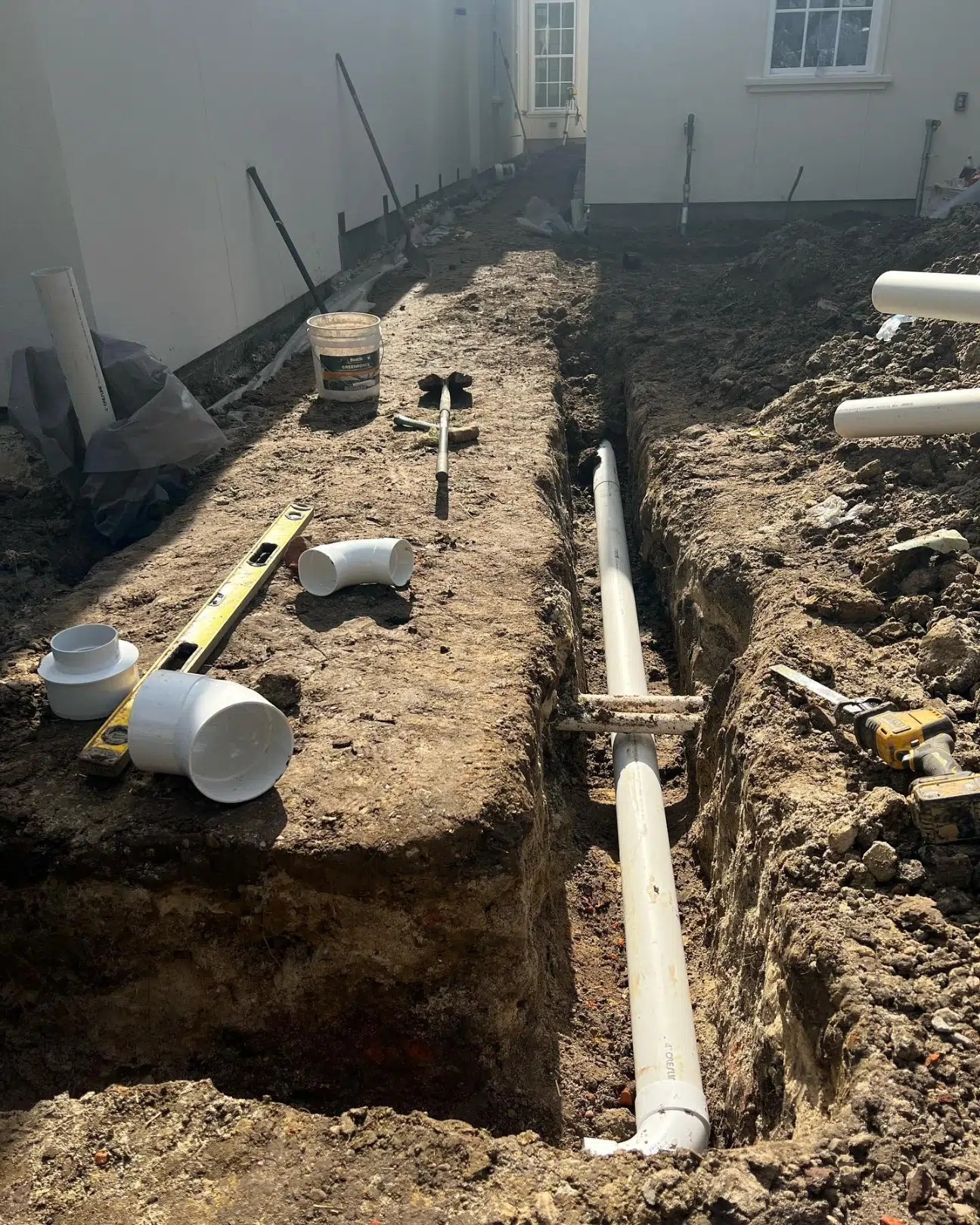
| French Drains | Yards with persistent low-spot pooling and no natural exit route | Perforated pipe buried in gravel collects subsurface water and redirects it to a drywell or discharge point | Eliminates standing water in chronically wet areas |
| Swales / Bioswales | Properties with space to construct vegetated channels | Shallow, graded trenches filled with vegetation slow and filter runoff | Reduces runoff velocity, filters pollutants, and encourages infiltration |
| Downspout Extensions | Homes with roof runoff concentrating near foundations | Extensions carry gutter discharge 4 or more feet from the house | Reduces water volume directly entering the soil near the foundation |
| Drywells | Properties where runoff needs underground dispersal | Gravel-filled chambers receive collected water and allow slow percolation | Handles high-volume runoff without surface ponding |
| Rain Gardens | Yards where runoff can be captured and filtered on-site | Depressed garden areas filled with native plants absorb and filter stormwater | Reduces runoff volume while adding landscaping value |
Source: Building America Solution Center
Why White Castle Properties Face Unique Drainage Challenges
White Castle sits in Iberville Parish along the Mississippi River corridor in south Louisiana. The combination of flat terrain, high water table, heavy annual rainfall, and proximity to bayous and canals creates conditions where water management is an ongoing concern, not a one-time fix. Louisiana experiences the second-highest annual number of thunderstorms in the contiguous United States, with a typical location averaging more than 60 per year, according to the Louisiana State Climate Summary. The August 2016 flooding event alone produced 20 to over 30 inches of rainfall across parts of the state in a matter of days.The state’s recognition of this risk is visible in infrastructure investment. The White Castle Canal Drainage Improvement Project received $2.56 million through the Louisiana Watershed Initiative for dredging and upgrades, a clear indication that drainage at both the municipal and property level is a priority in this area of the Louisiana Watershed Initiative.
Recommendations by Property Situation
Every property presents a different set of conditions. Here is how to match the solution to your situation.
| Property Condition | Recommended Approach | Key Notes |
|---|---|---|
| Flat yard with water pooling after every rain | Surface grading combined with French drains | Grading creates the initial slope; French drains handle water that cannot flow off the surface |
| The yard slopes toward the house | Swale installation along the property line with a berm | Swales intercept water before it reaches the foundation and redirect it along the property edge |
| Heavy clay soil that will not drain | French drains connected to drywells or discharge points | Subsurface systems bypass the impermeable soil layer entirely |
| Roof runoff causing foundation saturation | Downspout extensions plus surface grading | Extensions move water away; grading ensures it keeps flowing away |
| Low-lying yard with no natural exit for water | Rain garden or retention area with overflow swale | Captures and filters water on-site while providing controlled overflow |
| Recurring erosion in specific yard zones | Swales with berms and stabilized vegetation | Slows water velocity and allows infiltration before erosion occurs |
Signs You Have Found the Right Drainage Professional
Choosing someone to evaluate and fix your drainage goes beyond picking a name out of a search. Look for these indicators:
- Thorough site assessment before proposing solutions. A reputable professional walks the property during or after rain, identifies the exact flow patterns, and tests soil infiltration rates before making recommendations.
- Multiple solution options, not a single product pitch. The best evaluations present grading, drainage, and landscaping combinations tailored to your property’s specific conditions and constraints.
- Clear explanation of how each solution works and what it solves. You should understand why a French drain is being recommended for one area and a swale for another, not just receive a quote with line items.
- References to local soil conditions and rainfall patterns. Professionals familiar with White Castle and Iberville Parish understand the clay soils, high water table, and storm frequency that affect system design and longevity.
- Willingness to address the full system, not just the symptom. Redirecting a downspout without also fixing the yard slope that carries water back toward the house is a partial fix that will fail. The right approach evaluates the entire property as a connected system.
Get a Professional Drainage Assessment for Your White Castle Property
All Seasons Landscaping & Lawn Care provides drainage evaluations and solutions for residential and commercial properties throughout the White Castle area. Our team assesses your property’s unique conditions, identifies the root causes of water problems, and designs drainage systems built to handle Louisiana’s heavy rainfall. Contact us at [email protected] or call (225) 276-8658 to get started.
Frequently Asked Questions
How long should it take for standing water to drain from my yard after a storm?
Water should infiltrate or flow off your property within 24 hours of rainfall. If puddles remain after a full day, your drainage is inadequate and should be evaluated by a professional.
Can poor drainage cause foundation damage to my home?
Yes. Water pooling near your foundation creates hydrostatic pressure against walls, leading to cracks, moisture seepage, mold, and long-term structural shifting. Proper grading and drainage protect your foundation directly.
What drainage solutions work best for Louisiana’s heavy clay soil?
French drains connected to drywells or discharge points work well because they route water below the impermeable clay layer. Surface grading combined with swales provides additional above-ground management.
Does standing water in my yard actually attract mosquitoes?
Yes. The CDC identifies standing water as the primary breeding habitat for mosquitoes, whose larvae and pupae require stagnant water to survive. Eliminating standing water is one of the most effective methods of reducing mosquito populations around your home.
How do I know if my property’s grading is directing water toward or away from my house?
During or after rain, observe where water flows from your downspouts and across your yard. If water collects against your foundation or flows toward your house instead of away, your grade is likely negative and needs correction.
Sources
- Louisiana State Climate Summary – NCICS/NOAA – Comprehensive climate data for Louisiana, including annual precipitation averages of 57.2 inches, thunderstorm frequency exceeding 60 per year, and extreme precipitation event trends.
- Louisiana Watershed Initiative – White Castle Drainage Project – Details on the $2.56 million White Castle Canal Drainage Improvement Project funded through the Louisiana Watershed Initiative in 2021.
- EPA – What You Can Do to Soak Up the Rain – U.S. Environmental Protection Agency guidance on reducing stormwater runoff through downspout redirection, rain gardens, permeable surfaces, and site grading.
- Building America Solution Center – Swales, Drains, and Site Grading – U.S. Department of Energy technical guidance on stormwater control methods, including swale construction, French drain installation, and site grading specifications.
- CDC – What Mosquito Control Programs Do – Centers for Disease Control and Prevention information on the mosquito lifecycle, the role of standing water in mosquito breeding, and integrated mosquito management approaches.

- How Does Regular Hedge Trimming Improve Your Landscape’s Overall Appearance? - October 12, 2026
- The Complete Guide to Hedge Trimming, Care, Maintenance, and Healthy Growth - October 6, 2026
- How Can Professional Drainage Services in Central, LA Protect Your Property From Water Damage? - September 11, 2026