You step outside after sunset, and your property vanishes into darkness. Walkways become trip hazards. Your building’s architecture disappears. And that beautiful landscaping you invested in? Invisible for half the day. Outdoor lighting changes all of that, and it does far more than flip a switch on the darkness. When planned well, it makes your property usable after dark, adds a layer of personal safety, and can even reduce your energy bills compared to older technologies. For properties that need reliable illumination and thoughtful design, outdoor lighting services can provide a practical solution.
This guide pulls from our years of hands-on experience designing and installing outdoor lighting systems for homeowners and businesses. We have seen what works, what wastes money, and what common mistakes trip people up (sometimes literally). Whether you are lighting a residential garden path or a commercial parking lot, the principles here will give you a solid foundation for making smart decisions.
Why Outdoor Lighting Matters
Outdoor lighting serves three main purposes: safety, security, and aesthetics. Each matters on its own, but a well-designed system addresses all three.
Safety: Seeing Where You Walk
The most immediate benefit is personal safety. Unlit stairs, uneven walkways, and elevation changes become hazards after dark. Path lights, step lights, and low-level landscape lights mark these transitions so you and your guests can move around confidently. This is not just about convenience. Slips and falls are a real liability concern for businesses and a genuine danger for homeowners, especially those with older family members or young children.
A well-lit entrance also helps visitors and delivery drivers find your property without fumbling. It seems small, but it is the kind of detail that shapes someone’s first impression of your home or business.
Security: What the Research Actually Says
There is a widespread belief that brighter outdoor lighting automatically means less crime. The reality is more nuanced. Research published by the Office of Justice Programs found that upgraded street lighting had a measurable deterrent effect on violent crimes like robbery and assault. Still, property crimes like burglary were largely unaffected. Meanwhile, DarkSky International points out that poorly designed, overly bright lighting can actually decrease safety by creating glare that constricts pupils and deepens shadows where someone could hide.
What this means for you is that the quality and placement of your lighting matters more than raw brightness. Targeted, shielded fixtures that illuminate specific areas without flooding everything in light are more effective than a single blinding floodlight. Motion-sensor lights are a practical middle ground, providing illumination when someone approaches your property without leaving them on all night long.
Curb Appeal and Property Value
Outdoor lighting extends the visual life of your property well into the evening. Uplighting on trees, wall-washing on architectural features, and soft illumination along garden beds create an inviting atmosphere that stands out in any neighborhood. For businesses, exterior lighting signals that a property is active and well-maintained, which matters for customer perception and tenant retention. For homeowners, a thoughtfully lit exterior is one of the higher-return exterior improvements when it comes time to sell.
Key Takeaways:
- Outdoor lighting improves safety by illuminating walkways, steps, and transitions
- Quality and placement matter more than raw brightness for security purposes
- Glare from poorly designed fixtures can actually reduce safety by deepening shadows
- Exterior lighting boosts curb appeal and contributes to property value
The Main Types of Outdoor Lighting
Understanding the categories of outdoor fixtures helps you think about what your property actually needs. We break them into functional groups rather than just listing product types, because the function should drive the choice.
Path and Area Lighting
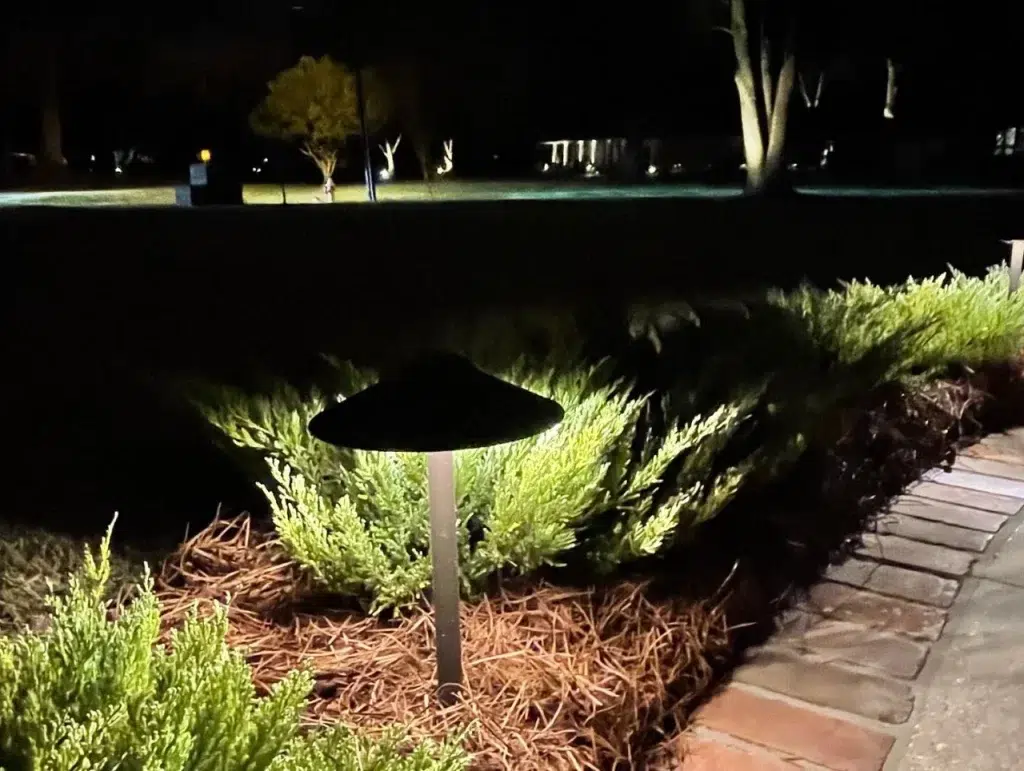
Path lights are the workhorses of residential outdoor lighting. They sit low to the ground, usually 18 to 24 inches tall, and cast a spread of light across walkways and garden borders. Bollard lights serve a similar purpose but are taller and more common in commercial settings like office parks and retail centers. The goal is even, low-level illumination that guides people without creating glare.
Expert Tip: Space path lights 6 to 8 feet apart for even coverage, and stagger them on alternating sides of the walkway rather than placing them in a rigid line. This creates a more natural look and avoids the “runway” effect.
Uplighting and Accent Lighting
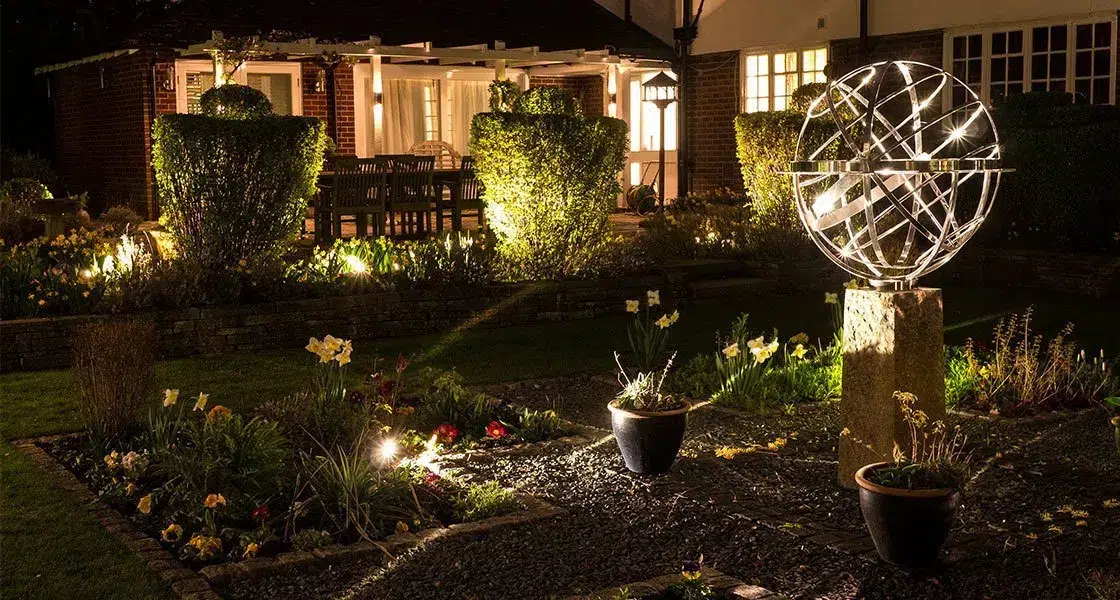
Uplights are fixtures placed at ground level and aimed upward to highlight trees, architectural columns, signs, or textured walls. They add drama and draw the eye to features you want to emphasize. Downlights, mounted in trees or on eaves, provide a softer, more natural-looking wash of light from above, mimicking moonlight. Both are essential tools for landscape and architectural lighting design.
Hardscape lights are a subset worth knowing about. These are small, low-profile fixtures recessed into retaining walls, steps, or patio caps. They are subtle during the day and produce a clean line of light at night that defines the geometry of outdoor structures. [Link to: Detailed Guide on Landscape Lighting Techniques]
Floodlighting and Security Lighting
Floodlights cast a broad, intense beam over a large area. They are the right choice for parking lots, driveways, and backyards where you need high visibility over a wide space. When paired with motion sensors, they serve as an effective security measure, activating only when movement is detected. The key is aiming them properly, using shielded fixtures that direct light downward rather than spraying it into neighbors’ windows or the night sky.
Deck, Patio, and Step Lighting
These fixtures are designed for outdoor living spaces. Recessed deck lights fit into the surface of the deck boards and illuminate the perimeter. Step lights mount on risers or side walls to mark each elevation change. Patio string lights and overhead fixtures add ambient light for dining and entertaining. This category bridges the gap between functional safety lighting and decorative atmosphere lighting.
Task Lighting for Specific Needs
Task lighting covers more specialized needs: grill lights for cooking areas, pool lights for swimming at night, and sign lights for business storefronts. These fixtures are chosen for their specific application rather than fitting into a broader design scheme, though they should still coordinate with the overall system in terms of color temperature and style.
Low Voltage vs. Line Voltage Systems
One of the most important decisions in any outdoor lighting project is the electrical system that powers it. There are two options, and they suit different situations.
Low Voltage (12V or 15V)
Low voltage systems use a transformer to step down standard 120V household current to 12 or 15 volts. The lights connect via a cable that can be buried just below the mulch or soil surface. This makes installation flexible and relatively non-invasive. You do not need to dig deep trenches or hire an electrician for every fixture placement.
Low voltage systems are the standard for residential landscape lighting because they are safer (the low voltage is harmless if the cable is accidentally cut), easier to route around existing landscaping, and compatible with a wide range of LED fixtures. They are also more energy efficient, which matters when you are running a system for several hours every night.
Line Voltage (120V)
Line voltage systems run directly off your home or building’s main electrical supply. They require conduit burial at regulated depths and must be installed by a licensed electrician. The fixtures are typically larger, brighter, and more durable, which makes them better suited to commercial applications, parking lot lighting, and high-wattage security floods.
Line voltage systems make sense when you need to cover large areas with high-output fixtures, or when code requirements dictate conduit installation for commercial properties. For most residential projects, low voltage is the better choice.
| Feature | Low Voltage (12V/15V) | Line Voltage (120V) |
|---|---|---|
| Installation | Flexible, shallow cable burial | Requires conduit, deeper burial |
| Safety | Safe if cable is cut | Potential shock hazard |
| Licensing | Often DIY-friendly | Licensed electrician required |
| Best For | Residential landscapes, gardens | Commercial lots, large areas |
| Fixture Options | Wide variety of LED fixtures | Larger, higher-output fixtures |
| Energy Use | Lower | Higher |
Expert Tip: If you are adding a small number of fixtures to an existing system, low voltage makes it easy to expand incrementally. You can tap into the cable at multiple points without running new circuits from the panel.
LED Technology and Energy Efficiency
The shift to LED technology has been the single biggest change in outdoor lighting over the past decade. LEDs have moved from a niche alternative to the default choice for virtually every application, and the data backs up why.
The Numbers Behind LED Adoption
According to the U.S. Department of Energy, LED penetration in the outdoor lighting market reached 51.4% in 2018, which was significantly higher than the 29.8% penetration in indoor applications at the time. Even more notably, outdoor LED lighting contributed 40% of the total energy savings from all LED lighting installations in 2018, despite representing a much smaller share of total installed units.
When municipalities switch to LED street and area lighting, the Department of Energy notes that energy savings can reach approximately 50% compared to conventional technologies, with an additional 20 to 40% savings possible through advanced controls like dimming and scheduling.
Why LEDs Dominate Outdoor Applications
The advantages are not limited to energy savings:
- Lifespan: Quality LED fixtures last 30,000 to 50,000 hours, compared to 2,000 to 5,000 hours for halogen or incandescent bulbs. For a system running 8 hours per night, that translates to 10 to 17 years before replacement.
- Durability: LEDs are solid-state devices with no fragile filaments or glass bulbs to break. They handle temperature extremes and vibration far better than older technologies, which matters in outdoor environments.
- Color Quality: Modern LEDs offer a range of color temperatures, from warm 2700K tones that complement architectural lighting to cooler 4000K options suitable for security areas. The color rendering index (CRI) of high-quality LEDs rivals or exceeds that of halogen.
- Directional Output: LEDs emit light in a specific direction, which means less light is wasted bouncing off reflectors. This makes it easier to design fixtures that put light exactly where you want it and nowhere else.
What About Solar-Powered Lights?
Solar lights have their place, particularly for remote areas where running wiring is impractical. However, for a primary lighting system, solar has limitations. Output is inconsistent (dependent on weather and seasons), the fixtures are typically lower brightness, and battery replacement every few years adds maintenance costs. We recommend solar for supplementary applications like garden accents, and wired LED for any fixture where consistent, reliable output matters.
Key Takeaways:
- LED adoption in outdoor lighting is significantly ahead of indoor applications
- LEDs offer 50% energy savings over conventional technologies in outdoor use
- Quality LED fixtures can last 10 to 17 years with nightly use
- Solar lighting works best as a supplement, not a primary system
Smart Lighting Controls
The technology that sits behind the fixtures has evolved as quickly as the fixtures themselves. Smart controls let you manage your outdoor lighting in ways that were not possible a decade ago.
Timers and Photocells
The most basic controls are still among the most useful. A timer ensures your lights turn on and off at set times. A photocell uses a light sensor to activate fixtures automatically at dusk and deactivate them at dawn. Combining both gives you flexibility, for example, keeping lights on for four hours after sunset rather than running them until dawn, which saves energy during the hours when nobody is using the space.
Motion Sensors
Motion-activated lighting is practical for security areas, side entrances, and driveways. The light stays off until it detects movement, then activates for a set duration. This saves energy, reduces light pollution during quiet hours, and has the added benefit of alerting you to activity on your property. Dual-technology sensors that combine infrared with microwave detection reduce false triggers from animals or wind-blown branches.
Smart Home Integration and App Control
Wi-Fi and Bluetooth-enabled controllers let you manage your outdoor lighting from a phone or tablet. You can create zones, adjust brightness levels, change color temperatures for seasonal effects, and set schedules for different areas independently. Some systems integrate with smart home platforms, so your outdoor lights can be part of broader automation routines, like having pathway lights turn on automatically when your security system is armed at night.
For commercial properties, centralized control systems can manage lighting across an entire campus, with the ability to dim or brighten zones remotely, monitor fixture status for maintenance alerts, and generate energy usage reports.
Expert Tip: When planning smart controls, start with the functions you actually need, not the maximum number of features. A reliable timer and photocell combination covers 80% of most residential needs at a fraction of the cost of a full smart system. You can always add app control and zoning later.
Responsible Outdoor Lighting and Dark Sky Compliance
This topic matters more than many people realize. Poorly designed outdoor lighting does not just waste energy. It creates light pollution that washes out the night sky, disrupts wildlife, and can even affect human health by interfering with circadian rhythms.
The Five Principles of Responsible Outdoor Lighting
DarkSky International and the Illuminating Engineering Society jointly published five principles that provide a clear framework for responsible lighting:
- Useful: All light should have a clear purpose. Before installing a fixture, ask what specific function it serves.
- Targeted: Light should fall only where it is needed. Use shielding and careful aiming to direct beams downward and prevent spill into unintended areas.
- Low Level: Light should be no brighter than necessary. Consider surface reflectivity, as some materials bounce more light than expected.
- Controlled: Light should only be on when needed. Timers, motion sensors, and dimmers ensure lights are active only during useful hours.
- Warm-Colored: Use warmer color temperatures where possible. Shorter wavelength (blue-violet) light has a greater impact on wildlife and human circadian rhythms, so limiting it is a simple but meaningful step.
Following these principles does not mean dim, inadequate lighting. It means lighting that works better because it is designed with intention rather than applied with excess.
What This Means for Your Project
In practice, responsible lighting means choosing fixtures with full cutoff or shielded designs that prevent light from escaping above the horizontal plane. It means selecting 2700K or 3000K LED color temperatures for residential areas instead of harsh 5000K daylight-balanced options. It means using motion sensors or timers instead of running floods all night. Many municipalities now have outdoor lighting ordinances that enforce some of these requirements, so checking your local codes before installing is a good idea regardless.
For businesses, dark sky compliance can be a selling point. Properties designed to minimize light pollution are increasingly attractive to tenants, customers, and municipalities alike, and some areas offer incentives for compliant installations.
Planning Your Outdoor Lighting Design
Whether you are a homeowner planning a single garden bed or a business owner managing a multi-building campus, the design process follows the same logic. Here is how we approach it.
Start with Purpose, Not Fixtures
The most common mistake we see is people shopping for fixtures before deciding what they want to achieve. The process should work the other way around. Walk your property at night first. Note which areas feel unsafe, which features you want to highlight, and where you need task lighting for specific activities. This becomes the basis of your design.
Layer Your Lighting
Good outdoor lighting, like good interior lighting, uses layers. The three main layers are:
- Ambient: General, overall illumination that provides a baseline level of visibility
- Task: Focused light for specific activities like grilling, reading, or walking on stairs
- Accent: Highlighting on trees, architecture, water features, or art
A property that only has floodlights lacks dimension. A property that only has tiny path lights lacks presence. Combining layers creates depth and visual interest.
Consider Maintenance from Day One
One issue we encounter regularly is systems that were installed without thought for future maintenance. Fixtures buried under mature shrubs that cannot be accessed, transformers mounted in low spots that flood during rain, or cables spliced above ground where they are exposed to lawnmowers. Planning for maintenance means mounting transformers in dry, accessible locations, using waterproof connectors at every splice, and placing fixtures where they can be reached for bulb or fixture replacement.
Expert Tip: Group your fixtures into zones that correspond to the areas they serve. This way, if one zone needs maintenance, you can shut down just that section without losing lighting across the entire property.
Design Differences for Homes vs. Businesses
Residential lighting design is typically about creating warmth and character. Lower light levels, warmer color temperatures (2700K to 3000K), and fixtures that complement the home’s style are the norm. The focus is on paths, entryways, gathering spaces, and landscaping.
Commercial lighting has additional considerations. Higher output is usually needed for parking areas, walkways between buildings, and signage. Code compliance for minimum light levels, uniformity ratios, and fixture shielding is mandatory in most jurisdictions. Energy codes may require specific controls or sensor technologies. The design needs to balance visibility and safety with energy efficiency and neighbor-friendly light management.
Common Mistakes and How to Avoid Them
After years of installing and troubleshooting outdoor lighting systems, we have seen the same issues come up repeatedly. Here are the most common ones and how to prevent them.
Overlighting
More light is not better light. Overlighting washes out contrast, creates glare, and contributes to light pollution. It also wastes energy. A common example is installing 10-watt LED path lights when 3-watt fixtures would produce a perfectly adequate wash of light. Start with less than you think you need. You can always add or increase output, but reducing an over-lit system means replacing fixtures or adding dimmers.
Ignoring Color Temperature
Mixing color temperatures within the same view is a visual problem. A 2700K warm path light next to a 5000K cool floodlight looks jarring. Plan your color temperatures consistently across the entire system. Warm tones (2700K to 3000K) work well for residential landscaping and architectural lighting. Cooler tones (4000K to 5000K) are better suited to security and commercial task lighting.
Poor Fixture Placement
Fixtures aimed at the wrong angle or placed too close to features create hot spots and uneven coverage. Uplights placed too close to a tree trunk create a bright circle at the base and leave the canopy in shadow. Path lights placed too far apart create pools of darkness between them. Taking the time to aim each fixture during installation, ideally after dark, makes an enormous difference in the final result.
Undersized Wiring and Transformers
Using cable that is too thin or transformers that lack sufficient capacity leads to voltage drop, where fixtures at the end of a run are noticeably dimmer than those near the transformer. This is a problem we see in DIY installations frequently. Proper sizing requires calculating the total wattage of your fixtures and the length of each cable run. A professional installer will account for this in the design, but if you are planning a system yourself, voltage drop calculators are available online and are worth using before you buy components.
Skipping the Nighttime Walk-Through
The single best thing you can do after installing a system is walk the property at night with all lights on. Look for glare from any angle, check for dark spots on paths, verify that uplights are hitting their targets, and confirm that no light is spilling into neighboring properties. Small adjustments at this stage, angling a fixture a few degrees or swapping a bulb for a different wattage, can turn an okay installation into one that looks intentional and polished.
Measuring the Value of Your Outdoor Lighting Investment
For homeowners, outdoor lighting value is relatively straightforward: it extends the usable hours of your property, improves safety, and enhances appearance. The return comes in daily quality-of-life benefits and long-term property value.
For businesses, the equation is more quantifiable. Reduced liability exposure from well-lit walkways, lower energy costs from LED efficiency, improved tenant or customer perception, and potential compliance with insurance or municipal requirements all contribute to measurable returns. The outdoor lighting market has been growing steadily as a result, with projections showing continued expansion driven by smart city initiatives and energy efficiency regulations.
Putting Your Outdoor Lighting Strategy into Action
Outdoor lighting is one of those investments that pays dividends every single evening. The right system makes your property safer to navigate, more inviting to approach, and more enjoyable to spend time in after dark. The wrong system wastes energy, creates glare, and becomes a maintenance headache.
The fundamentals covered here- choosing the right fixtures, selecting an appropriate voltage system, investing in LED technology, applying responsible lighting principles, and planning for long-term maintenance- give you everything you need to make informed decisions. Whether you are starting from scratch or upgrading an existing system, the principles are the same: start with purpose, use quality components, and design with the night in mind.
Bookmark this guide and come back to it as you work through your project. The details matter more at night than during the day, and getting them right the first time saves time, money, and frustration.
Need Expert Guidance?
If you are ready to plan or upgrade your outdoor lighting system, we would be happy to help. Our team at All Seasons Landscaping & Lawn Care brings hands-on experience with both residential and commercial projects. Reach out to us at [email protected] or call (225) 276-8658 to discuss your property and explore what a well-designed lighting system can do for you.
Frequently Asked Questions About Outdoor Lighting Solutions
How long does an outdoor LED lighting system last?
Most quality LED fixtures rated for outdoor use will last 30,000 to 50,000 hours. Running roughly 8 hours per night, that works out to 10 to 17 years of service before the LED reaches end of life. Transformers and wiring typically outlast the fixtures themselves when properly installed.
Can I install a low voltage outdoor lighting system myself?
Many homeowners successfully install low voltage systems, especially smaller setups with fewer fixtures. The low voltage makes it safe to work with, and cable burial is shallow. Larger systems, or those covering multiple zones, benefit from professional design to ensure proper transformer sizing and cable routing. Line voltage systems always require a licensed electrician.
What is the difference between 2700K and 5000K outdoor lights?
Color temperature, measured in Kelvin, describes the warmth or coolness of light. A 2700K bulb produces a warm, slightly yellow-white light similar to traditional incandescent bulbs. A 5000K bulb produces a cool, bluish-white light closer to daylight. Warm tones (2700K to 3000K) are standard for residential landscapes. Cooler tones (4000K to 5000K) are typically used for security and commercial task lighting.
Do outdoor lights need to be on all night?
Not necessarily. Timer and photocell controls let you set lights to operate only during specific hours, like from dusk until midnight. Motion-activated security lights only turn on when movement is detected. Running lights only when needed saves energy and reduces light pollution without sacrificing safety during the hours your property is actually in use.
Will outdoor lighting bother my neighbors?
It does not have to. Shielded fixtures direct light downward onto your property rather than sideways or upward. Selecting warm color temperatures and appropriate brightness levels further reduces the chance of light trespass. A nighttime check from your neighbor’s perspective after installation is a good practice to confirm your system is not causing issues.
How much maintenance does an outdoor lighting system require?
LED systems need minimal maintenance compared to older halogen or incandescent setups. The main tasks are periodically cleaning fixture lenses (dirt and debris reduce output), checking for any fixtures that have shifted out of position, and trimming plant growth that may be blocking light. Most homeowners handle this a couple of times per year. Transformer and wiring connections should be checked every few years.
What is dark sky compliant lighting?
Dark sky compliant lighting refers to fixtures designed to minimize light pollution by directing all light downward, preventing it from escaping above the horizontal plane. These fixtures use shielding or cutoff designs, and they typically use warm color temperatures. Organizations like DarkSky International maintain certification programs that identify compliant products. Using these fixtures is not just environmentally responsible; many municipalities now require them.
Sources
- U.S. Department of Energy – LED Adoption Report – DOE report on LED penetration rates and energy savings across U.S. lighting applications
- U.S. Department of Energy – SSL Forecast Report – DOE projections for LED energy savings through 2035
- DarkSky International – Five Principles for Responsible Outdoor Lighting – Joint publication with IES on responsible outdoor lighting guidelines
- DarkSky International – Outdoor Lighting and Safety – Research on the relationship between outdoor lighting, crime, and safety
- Office of Justice Programs – Impact of Street Lighting on Crime – NIJ-funded study on crime deterrence effects of improved street lighting

- How Can Professional Drainage Services in Central, LA Protect Your Property From Water Damage? - September 11, 2026
- Which Areas of Your Property Benefit Most From Outdoor Lighting for Safety and Curb Appeal? - September 11, 2026
- How Does Professional Outdoor Lighting Transform Your Landscape at Night in Baton Rouge, LA? - September 9, 2026