The bulbs on your porch or patio are not all equally appealing to insects, and the reason comes down to how insects perceive light. Most insects, including mosquitoes, see wavelengths that humans cannot, particularly ultraviolet (UV) light in the 300 to 400 nanometer range. When a bulb emits UV or blue-rich light, insects detect it strongly and orient toward it. Recent research published in Nature Communications reveals that insects do not actually fly directly toward light sources. Instead, they turn their backs (dorsum) toward the brightest visual region to maintain flight stability, which causes them to orbit, stall, and crash near artificial lights. This dorsal-light-response explains why some fixtures become insect magnets while others go largely unnoticed.
In a subtropical city like New Orleans, where mosquito season stretches from early spring well into fall, choosing the right outdoor bulb matters for comfort and public health. The City of New Orleans NOLA Ready office notes that warm temperatures and frequent rainfall create ideal mosquito breeding conditions, and mosquitoes in the area can carry diseases like West Nile and Zika viruses. The U.S. Environmental Protection Agency recommends replacing standard outdoor lights with yellow “bug” lights, which attract fewer mosquitoes than ordinary bulbs. Understanding the science behind these recommendations helps you make smarter choices for your property.
TL;DR
- Insects see UV and blue wavelengths that humans cannot, making bulbs rich in those wavelengths far more attractive to them
- A 2024 study in Nature Communications confirmed that insects turn their dorsal side toward artificial light to maintain flight balance, causing erratic orbiting behavior rather than direct attraction
- Warm LED bulbs rated at 3000K or below emit longer wavelengths (yellow, amber, red) that fall outside most insects’ visual range
- Yellow “bug” lights attract significantly fewer mosquitoes but do not repel them, according to the EPA
- New Orleans’ warm, humid climate extends mosquito activity across much of the year, making Outdoor Lights especially important
- Compact fluorescent (CFL) bulbs emit some UV radiation during normal operation and tend to attract more insects than LEDs
- LED technology offers energy efficiency combined with the ability to select insect-friendly color temperatures
- Fixture placement matters as much as bulb selection; positioning lights away from doors and seating areas reduces the insect presence near people
The Science of Insect Vision and Light Attraction
Insects experience the world of light differently than we do. According to UF/IFAS Extension, insects see the electromagnetic spectrum from roughly 650 nanometers (red) down to 300 nanometers (UV). Humans top out around 400 nanometers. This means insects perceive an entire range of ultraviolet light that is invisible to us.
Within that expanded range, insects are most sensitive to UV, green, and blue light. They have difficulty seeing yellow and orange, and most species cannot see red at all. When a bulb emits strong UV or blue wavelengths, it registers as a powerful visual signal to nearby insects.
But why do insects swarm around lights rather than simply flying to them? The 2024 Nature Communications study used high-resolution motion capture and stereo videography to reconstruct three-dimensional flight paths. The researchers found that insects consistently tilt their dorsal (top) surface toward the brightest light source. Under natural sky light, this behavior helps them stay upright and maintain stable flight. Near an artificial point source, however, this dorsal-light-response produces continuous steering loops, orbiting, and stalling that trap the insect around the fixture. For homeowners and businesses planning exterior illumination, an outdoor lighting guide can provide useful guidance on selecting and positioning lighting more effectively.
A 2025 study published in the journal Insects and available through PubMed Central took this further by identifying the specific genes responsible. Researchers found that three opsin genes (CqOpsin3, CqOpsin5, and CqOpsin6) in Culex quinquefasciatus mosquitoes mediate UV light attraction. When these genes were silenced, mosquitoes no longer showed positive phototaxis toward UV light. This species is one of the most common mosquitoes in the southern United States and is a primary vector for West Nile virus.
Why New Orleans Properties Face Greater Challenges
New Orleans sits in a humid subtropical climate with warm temperatures and frequent rainfall for much of the year. The city is located below sea level, which creates natural water collection areas where mosquitoes breed. Humidity levels frequently exceed 80 percent, providing the moisture mosquitoes need to thrive.
According to NOLA Ready, mosquito season in New Orleans usually begins in spring and slows in the fall, though mild winters can extend activity. Louisiana has more than 60 mosquito species, with the most common in the New Orleans area being the Asian tiger mosquito, the Southern house mosquito, and the yellow fever mosquito. These conditions mean that outdoor lighting decisions have a direct, season-long impact on how usable your yard and patio remain, making outdoor lighting installation an important consideration when planning an exterior lighting system.
What Makes One Bulb Attract More Insects Than Another
The insect appeal of any given bulb depends on three primary factors: the wavelengths it emits, its color temperature, and the intensity of its UV output.
The wavelength spectrum is the most important factor. Bulbs that produce light in the UV range (below 400 nm) or strong blue light (400 to 500 nm) will attract the most insects. This is why bug zappers use UV bulbs to draw insects in.
Color temperature, measured in Kelvin (K), indicates the warmth or coolness of visible light. Lower Kelvin values produce warmer, yellower light; higher values produce cooler, bluer light. Bulbs rated at 5000K or above mimic daylight and emit significant blue wavelengths. Bulbs at 2700K to 3000K produce a warm white glow with far less blue content.
Bulb technology also plays a role. Incandescent and halogen bulbs produce broad-spectrum light that includes some UV. Compact fluorescent bulbs emit small amounts of UV radiation as part of their normal operation. LEDs, by contrast, produce very little UV when manufactured with proper phosphor coatings, making them inherently better suited for insect-conscious outdoor use.
How to Choose the Right Outdoor Bulb
Bulb Type Comparison
| Bulb Type | UV Emission | Blue Content | Insect Attraction | Energy Efficiency |
|---|---|---|---|---|
| Incandescent | Low | Moderate | Moderate | Low |
| Halogen | Low | Moderate | Moderate | Low |
| Compact Fluorescent (CFL) | Some UV | Moderate | Moderate-High | Moderate |
| Cool White LED (5000K+) | Very Low | High | High | High |
| Warm White LED (2700K-3000K) | Very Low | Low | Low | High |
| Yellow Bug Light LED | Very Low | Minimal | Minimal | High |
| Red LED | Very Low | None | Very Low | High |
Color Temperature Recommendations
| Color Temperature | Light Appearance | Wavelength Profile | Best Application |
|---|---|---|---|
| Below 2700K | Warm amber/red | Long wavelengths only | Areas where insect reduction is top priority |
| 2700K to 3000K | Warm white | Low blue content | Patios, porches, entry areas |
| 3000K to 4000K | Neutral white | Moderate blue | Driveways, walkways (some attraction) |
| 5000K+ | Cool/daylight | High blue content | Security lighting (expect more insects) |
Our Recommendations by Application
For New Orleans homeowners dealing with prolonged mosquito seasons, our recommendations depend on how you use each area:
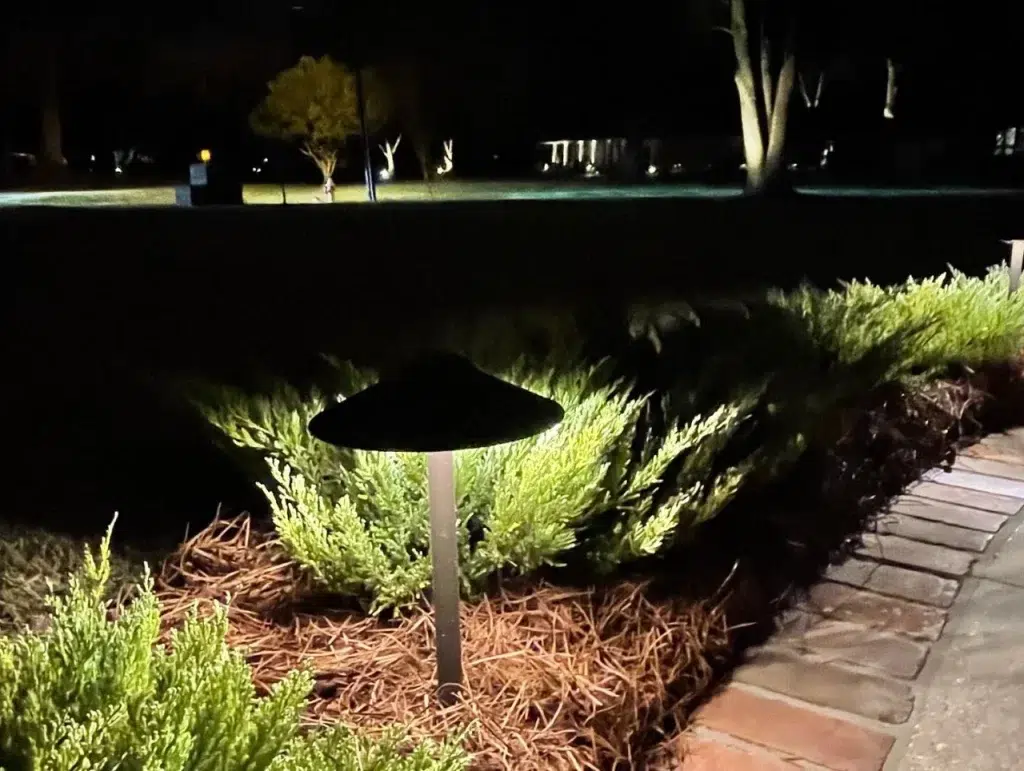
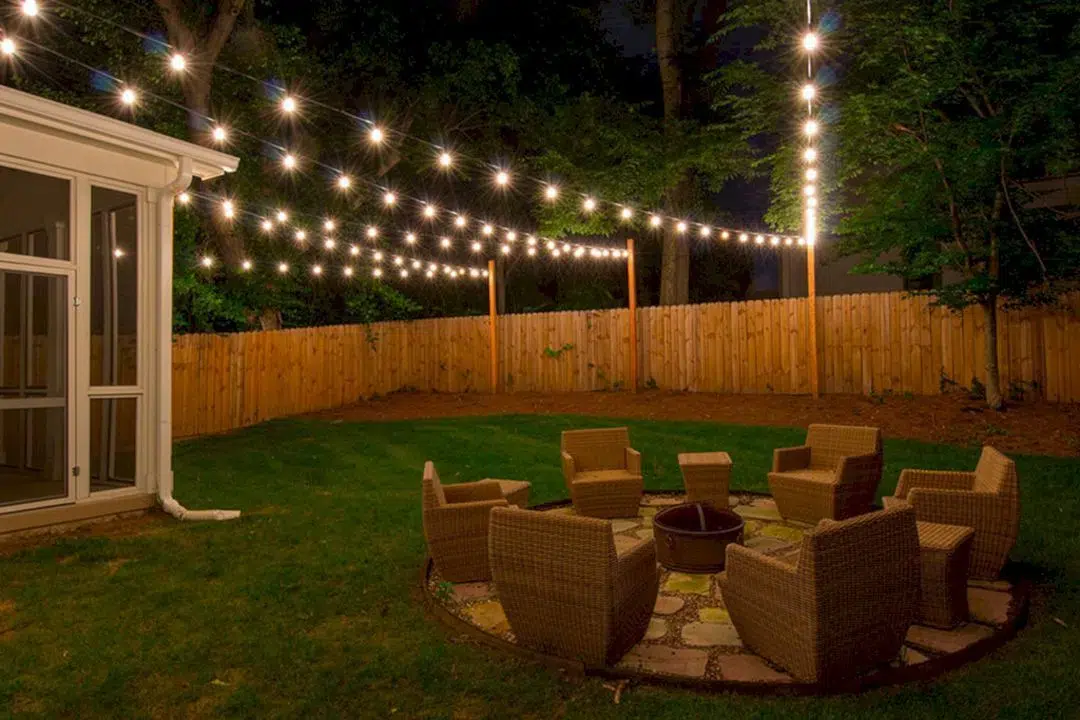
Patio and dining areas where people gather should use warm white LEDs at 2700K or dedicated yellow bug lights. These emit the longest visible wavelengths and fall at the edge of what most insects can perceive.
Path and landscape lighting can use warm white LEDs (2700K to 3000K). Since these fixtures are typically lower to the ground and placed away from seating, moderate insect attraction has less impact on comfort.
Security and flood lighting present a trade-off. Higher Kelvin bulbs (4000K to 5000K) offer better visibility and color rendering for cameras, but they attract more insects. If insect pressure is a concern, consider warm white LEDs paired with motion sensors so the light is not running continuously.
Entryways and door areas benefit most from yellow bug lights or warm amber LEDs. Since people pass through these zones frequently, reducing the insect swarm near doors has the most practical benefit.
Placement Strategies That Complement Bulb Choice
Selecting the right bulb is only part of the solution. How and where you position fixtures makes a meaningful difference:
- Direct light downward using shielded fixtures or downlights. Ground-reflected UV and blue light still attract insects, but downward-directed warm light minimizes visible scatter.
- Place fixtures away from doors and seating areas when possible. Even insect-friendly bulbs will draw some insects, and positioning the source a few feet from high-traffic zones keeps them away from people.
- Use motion sensors or timers so lights operate only when needed. Continuous nighttime lighting gives insects a steady target for hours.
- Avoid placing lights near standing water features if possible. Water attracts mosquitoes on its own, and adding a light source nearby creates a dual attraction point.
Signs You Have the Right Outdoor Lighting Setup
A well-configured outdoor lighting system shows several practical indicators. You will notice fewer insects circling your porch and entry fixtures after switching to warm or amber bulbs. Your patio remains usable in the evening without constant swatting or citronella candles. Flood and security lights activate only when triggered rather than running all night, and your fixtures direct light where it is needed rather than broadcasting it in all directions. Local service reviews can also help homeowners evaluate professionals for outdoor lighting and related landscape services.
The right approach also aligns with what the EPA and local agencies recommend. The EPA specifically notes that yellow bug lights “tend to attract fewer mosquitoes than ordinary lights” while clarifying that they are not repellents. The NOLA Ready office emphasizes reducing standing water alongside personal protection measures. Lighting is one piece of an integrated approach, not a standalone solution.
Request Your Outdoor Lighting Quote
All Seasons Landscaping & Lawn Care designs and installs outdoor lighting systems tailored to the unique conditions of Louisiana properties. Our team evaluates your site, recommends fixtures and bulbs that minimize insect attraction, and positions everything for maximum enjoyment of your outdoor spaces. Whether you are upgrading a patio, lighting a pathway system, or building new landscape illumination from scratch, we handle the full process.
Contact us at [email protected] or call (225) 276-8658 to get started.
Frequently Asked Questions
Why do yellow bug lights attract fewer insects?
Yellow and amber lights emit longer wavelengths that fall near the edge of or outside most insects’ visible spectrum. According to UF/IFAS research, insects have difficulty seeing yellow and orange wavelengths and cannot see red at all. The EPA recommends yellow bug lights for this reason, though they clarify these lights are not repellents.
Does LED technology make a difference for insect attraction?
LEDs produce very little ultraviolet radiation when built with proper phosphor coatings, which gives them an inherent advantage over CFLs that emit some UV during normal operation. The real factor with LEDs is the color temperature you select. A warm white LED at 2700K attracts far fewer insects than a cool white LED at 5000K.
Is the insect problem around my lights actually a mosquito problem?
Not necessarily. Moths, beetles, gnats, and flies are all drawn to artificial light, often in larger numbers than mosquitoes. The Nature Communications study observed this behavior across 10 insect orders. Reducing UV and blue wavelengths helps reduce the entire insect population around your fixtures, not just mosquitoes.
Will switching to warm bulbs eliminate insects from my yard completely?
No bulb choice eliminates all insect activity. Warmer bulbs and yellow bug lights significantly reduce the number of insects swarming your fixtures, but some species will still detect the light. The EPA explicitly states that yellow lights are not repellents. Combining smart bulb selection with proper placement, motion sensors, and standing water elimination produces the best results.
Should I remove my existing fixtures or just change the bulbs?
In many cases, simply swapping the bulb is sufficient. However, if your current fixtures are unshielded and broadcast light in all directions, upgrading to downlighting or shielded fixtures will further reduce the visible light scatter that attracts insects from a distance. Our team can evaluate whether your existing fixtures support the right bulb types or need replacement.
Sources
- Nature Communications – Why Flying Insects Gather at Artificial Light – 2024 peer-reviewed study using 3D motion capture to demonstrate that insects orbit artificial lights by tilting their dorsal surface toward the source, disrupting their flight stability.
- U.S. EPA – Tips to Prevent Mosquito Bites – Official EPA guidance recommending yellow “bug” lights for outdoor use to attract fewer mosquitoes than ordinary lights.
- NOLA Ready – Mosquito-Borne Disease – City of New Orleans emergency preparedness resource describing the local mosquito season, disease risks (West Nile, Zika), and population control efforts.
- UF/IFAS Extension – Insect Vision and Colors – University of Florida Extension article explaining that insects see from 650nm to 300nm, are most attracted to UV light, and cannot see red.
- PubMed Central – UV Light-Mediated Attraction in Culex Mosquitoes – 2025 study identifying three opsin genes responsible for UV phototaxis in Culex quinquefasciatus, a common southern U.S. mosquito species and West Nile vector.